

Vamana Procedure: Step-by-Step Guide
Vamana therapy is a detoxification process from Ayurveda, aimed at removing excess Kapha dosha and toxins through controlled vomiting. It's part of Panchakarma, a system of cleansing therapies. Here’s what you need to know:
- Purpose: Treats conditions like asthma, bronchitis, obesity, psoriasis, and PCOS. Best performed in spring when Kapha levels peak.
- Preparation (Purva Karma): Lasts 7-12 days, involving dietary changes, medicated ghee intake, massages, and steam therapy to mobilize toxins.
- Main Procedure (Pradhana Karma): Emetic herbs are administered early morning to induce vomiting. Success is measured by the expulsion of bile (Pitta), signaling toxin removal.
- Post-Care (Paschat Karma): A structured recovery diet (Samsarjana Krama) helps rebuild digestive strength over 3–7 days. Rest and minimal activity are crucial.
Key Benefits: Improved digestion, respiratory health, hormone balance, and mental clarity. Always consult a qualified Ayurvedic practitioner before undergoing Vamana.
For a deeper dive into the process, preparation, and aftercare, read on.
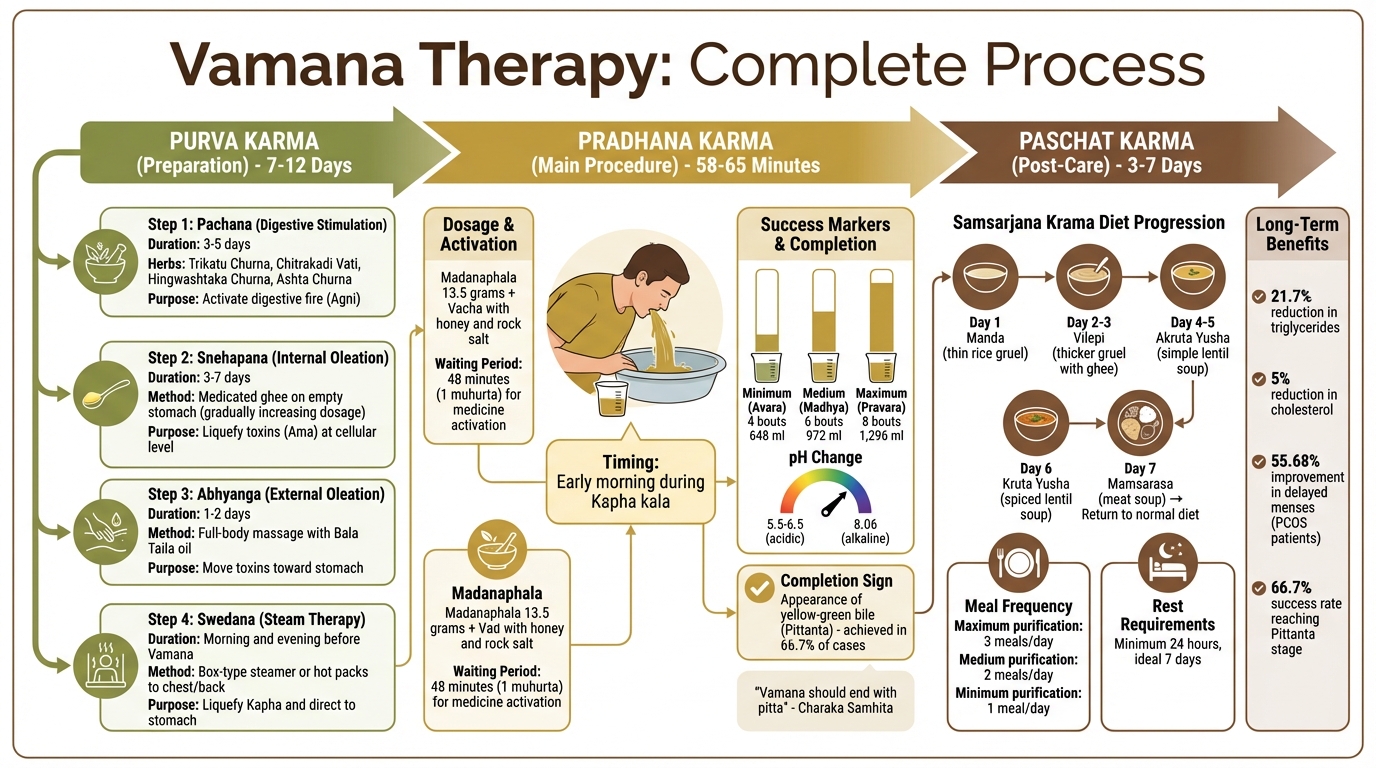
Vamana Therapy Three-Phase Process: Preparation, Procedure, and Recovery Timeline
Purva Karma: Preparation Steps
The preparation phase, or Purva Karma, generally lasts 7 to 12 days. Its purpose is to loosen toxins from deep tissues and guide them toward the stomach. Without these preparatory steps, removing Kapha from the extremities becomes difficult, and the main procedure may not achieve its intended results. This phase includes specific dietary and oleation protocols to ensure effective toxin mobilization.
Dietary Adjustments
Adjusting your diet is a critical first step for mobilizing toxins and stimulating digestion. This begins with Pachana, or digestive stimulation, which spans 3 to 5 days. During this time, herbal formulations such as Trikatu Churna, Chitrakadi Vati, Hingwashtaka Churna, or Ashta Churna are taken to activate the digestive fire (Agni). A strong metabolism is essential for processing the medicated oils that follow.
Before the Vamana procedure, your diet shifts to a Kapha-increasing regimen (Kaphotklesha). Foods like sweet yogurt, black gram, fish, sesame, shrikhand, and fermented items are included to agitate Kapha. On the morning of the procedure, eating basmati rice with salty yogurt further enhances this effect.
Internal and External Oleation (Snehana)
Once digestion is stimulated, the next step is Snehapana, or internal oleation with medicated ghee, for 3 to 7 days. The dosage of ghee is gradually increased each morning on an empty stomach. This process liquefies toxins (Ama) and detaches them from body tissues (dhatus).
"By virtue of its ushna (hot) and tikshna (sharp) properties, the accumulated doshas get liquified and break up into small pieces at cellular level." - Dr. Meenakshi Chauhan, Planet Ayurveda
Following internal oleation, Abhyanga, a full-body massage using oils like Bala Taila, is performed for 1 to 2 days. This external treatment helps move toxins toward the stomach. It’s important to avoid daytime naps during this phase to keep digestion active.
Steam therapy is then introduced to further liquefy Kapha, making the elimination process smoother.
Swedana: Steam Therapy
The final step in preparation is Swedana, or steam therapy, conducted morning and evening on the day before Vamana. This can involve using a box-type steamer (Bashpa Swedana Yantra) or applying hot packs to the chest and back. The heat helps liquefy Kapha and directs it into the Amashaya (stomach) for easier removal.
"When there is the appearance of sweat, it indicates that the dosha has been liquified." - Dr. Meenakshi Chauhan, M.D., Planet Ayurveda
Signs of successful Swedana include perspiration on the forehead or body and sometimes goosebumps, indicating that toxins are detaching from tissues. On the morning of Vamana, hot packs are applied to the chest and back to dissolve respiratory Kapha before administering emetic herbs.
Pradhana Karma: The Main Procedure
After completing the preparatory steps (Purva Karma), Vamana begins early in the morning during Kapha kala, ensuring the patient has had a full night's rest and fully digested their previous meal. From start to finish, the process generally lasts 58 to 65 minutes.
Administering Emetic Herbs
The procedure starts with Akanthapana, where the patient consumes liquids like milk, sugarcane juice, or Yashtimadhu decoction to prepare for vomiting. Following this, a combination of emetic herbs is administered. The most commonly used herbs are Madanaphala (Randia dumetorum) and Vacha (Acorus calamus), provided as a powder, paste, or decoction mixed with honey and rock salt.
For dosage, Madanaphala is typically given in an amount equal to one closed fist (about 13.5 grams). After ingesting the herbs, the patient waits for one muhurta (approximately 48 minutes) for the medicine to activate the doshas. If vomiting does not occur naturally, the patient can stimulate it by tickling their palate with their fingers or a soft stalk. During this phase, the physician closely monitors as the body begins to expel toxins.
Monitoring the Process
During the procedure, the patient is seated on a knee-high chair, leaning slightly forward with their upper body bent to aid in the elimination process. Attendants provide physical support, holding the patient's forehead and sides while gently massaging the back upward to encourage the release of doshas. This combination of physical assistance and careful observation ensures the process is both safe and effective.
"The first effect of the administration of decoction would be perspiration which indicates that the Dosha has started melting." - Dr. Meenakshi Chauhan
The physician examines the expelled vomitus in a spittoon to observe the sequence of dosha expulsion. Typically, Kapha is expelled first, followed by Pitta, and finally a small amount of Vata. Pulse and blood pressure are monitored throughout, while the vomitus pH transitions from acidic (5.5–6.5) to a more alkaline level of around 8.06 when bile appears.
Signs of Completion
The success of the procedure is evaluated using three key criteria: Vaigiki (number of vomiting bouts), Maniki (quantity of vomitus), and Antiki (visual observation of vomitus). The appearance of Pitta (yellowish-greenish bile) in the vomitus, referred to as "Pittanta", is the primary marker of completion.
| Purification Level | Number of Bouts | Quantity of Vomitus |
|---|---|---|
| Maximum (Pravara) | 8 Bouts | 1,296 ml (2 prastha) |
| Medium (Madhya) | 6 Bouts | 972 ml (1.5 prastha) |
| Minimum (Avara) | 4 Bouts | 648 ml (1 prastha) |
"Pittantamistham vamanam" (Vamana should end with pitta). - Charaka Samhita
The procedure concludes as soon as bile appears in the vomitus. Signs of successful completion include a feeling of lightness in the chest and head, improved sensory clarity, a bitter taste in the mouth, and an end to vomiting. Clinical studies reveal that about 66.7% of participants reach the Pittanta stage, indicating effective Kapha elimination.
Paschat Karma: Post-Procedure Care
After Vamana concludes at the Pittanta stage, your digestive fire (Agni) is at its lowest, making recovery a top priority. The post-procedure care, known as Paschat Karma, is designed to carefully rebuild your digestive strength. A key part of this process is following the Samsarjana Krama, a structured dietary progression to restore balance.
Samsarjana Krama: Gradual Diet Progression
The Samsarjana Krama regimen transitions your diet from liquid to solid foods over a span of 3 to 7 days, depending on the level of purification achieved during Vamana. Meal frequency also varies: three meals per day for maximum purification, two for moderate, and one for minimal.
The dietary progression follows this sequence: Manda → Vilepi → Akruta Yusha → Kruta Yusha → Mamsarasa. For those who underwent maximum cleansing, this process typically extends to the seventh night, after which a regular diet can be resumed. Start with plain Manda for the first three meals, avoiding salt or fats. Gradually introduce small amounts of ghee or oil during the Vilepi stage (meals 4–6).
"Just as a spark of fire after being fed by grass, powder of dry cow dung etc., gets augmented gradually and becomes great, steady, and capable of burning everything, similarly, the internal digestion fire, by the Samsarjana regimen... gains strength." - Charaka Samhita
Rest and Lifestyle Adjustments
Recovery requires more than just dietary care. Rest in a room protected from drafts, use lukewarm water for cleaning, and allow your body to reset naturally. Physical exertion, emotional stress, and environmental irritants should be minimized for at least 24 hours, though a full 7 days is ideal. Emotional balance is especially important, as stress can aggravate Vata.
Supplementary Support
To enhance recovery, consider targeted supplementation. Products like TUDCA & NAC from Mahoney Supplements ($92.00) can support liver detoxification and help process toxins more effectively. These supplements also ease die-off symptoms, ensuring a smoother transition as you follow the Samsarjana Krama. Additionally, Dhumapana, a post-procedure practice, can help clear any lingering Kapha from the system.
sbb-itb-9616115
Prerequisites and Contraindications
Vamana requires thorough evaluation to ensure both its safety and effectiveness. Below, we’ll cover who can benefit from the procedure and when it should be avoided.
Ideal Candidates for Vamana
Vamana is particularly helpful for individuals with pronounced Kapha imbalances. Signs of aggravated Kapha include heaviness, excessive salivation, lethargy, and persistent drowsiness. This therapy is especially recommended for managing respiratory conditions like chronic asthma, bronchitis, sinusitis, and long-term coughs. It’s also considered beneficial for certain skin conditions, such as psoriasis, eczema, vitiligo, and urticaria. Additionally, Vamana may assist with metabolic concerns, including obesity, diabetes, thyroid issues, and polycystic ovarian disorder (PCOD).
However, candidates must have adequate physical and mental resilience. A complete medical evaluation is necessary before proceeding. This includes tests like ECG, liver function, blood sugar, lipid profiles, and stool/urine analysis. The spring season (March–April) is often preferred for Vamana, as Kapha naturally tends to accumulate during this time.
Knowing who can benefit from Vamana also helps us identify situations where the procedure is unsuitable.
When to Avoid Vamana
Vamana should not be performed on pregnant women, children, elderly individuals, or those who are severely weakened or emaciated. It’s also contraindicated for people with heart conditions, active bleeding disorders (like hemoptysis or frequent nosebleeds), or other cardiovascular problems. Those with abdominal conditions such as ascites, splenomegaly, intestinal obstructions, or tumors are also not suitable candidates.
Digestive health is another critical factor. Avoid Vamana in cases of indigestion, extreme hunger, or overly active digestion, as the emetic medicine may be absorbed rather than inducing vomiting. Administering Vamana to inappropriate candidates can result in severe complications, including tympanitis, palpitations, internal organ displacement, and, in rare cases, life-threatening consequences. Always ensure the procedure is conducted under the guidance of a qualified Ayurvedic practitioner.
Measuring Success and Long-Term Benefits
Criteria for Success: Shuddhi Levels
After completing the procedure, success is evaluated using four key criteria - Antiki, Vaigiki, Maniki, and Laingiki. The endpoint is marked by the appearance of yellow or green bile, which clinical data shows is achieved in 66.7% of cases. This bile, identified by its bitter taste and distinctive color, signals the successful expulsion of toxins.
Purification levels are categorized as maximum, moderate, or minimum, depending on the frequency of vomiting bouts and the total volume expelled. Biochemical analysis reveals a significant change in the vomitus' pH, shifting from an acidic 5.5 during the initial stages to an alkaline 8.06 in the final stages - clear evidence of Pitta elimination.
Physical indicators of successful completion include a sense of lightness in the body, clarity in the chest and head, improved sensory perception, and the natural cessation of vomiting urges.
Maintaining Health Post-Vamana
Once purification is achieved, it’s crucial to maintain the benefits through proper post-procedure care. Dietary discipline and specific supplements play an important role. For ongoing detox support, products like ParaGon for parasite cleansing and B17 for immune health from Mahoney Supplements can be helpful.
Adhering to the Samsarjana Krama diet for 3–7 days is essential. Start with a thin rice gruel and gradually transition to thicker foods. During this period, avoid activities like loud speaking, long walks, anger, and exposure to harsh elements like sun or wind for at least 24 hours. To maintain results, consider undergoing Vamana seasonally, particularly in spring (March–April), when Kapha naturally tends to accumulate.
Long-Term Benefits of Vamana
The long-term effects of Vamana extend across multiple body systems, offering improvements that go beyond detoxification. The therapy enhances digestive fire (Agni) and boosts metabolism. Research indicates that Vamana can lower serum triglycerides by around 21.7% and cholesterol levels by approximately 5%. Additionally, it supports mental clarity, strengthens immunity, and helps prevent the recurrence of chronic conditions like asthma, psoriasis, and obesity.
"The sense organs, mind, intelligence, and complexion become clear and gain strength; the person gains strength, nourishment and immunity." - Easy Ayurveda
Many participants report calmer thoughts and sharper sensory perception. Vamana also aids in tissue stability (Dhatu Sthiratva), promotes healthier skin, and supports reproductive health. By addressing imbalances in Kapha at their root, the therapy may slow aging and contribute to a longer, healthier life. For instance, studies on PCOS patients have shown a 55.68% improvement in delayed menses, highlighting Vamana's potential for hormonal regulation and balance.
Conclusion: The Vamana Process for Natural Health
The Vamana procedure provides a structured method for natural detoxification, focusing on eliminating excess Kapha dosha from the chest and stomach regions. By mobilizing and expelling toxins, the process helps restore balance, with the presence of bile indicating successful removal of the excess Kapha.
After detoxification, proper post-procedure care is crucial to maintain this restored balance. The Samsarjana Krama diet, followed over 3–7 days, gradually rebuilds digestive strength, reducing the risk of complications and supporting long-term benefits. Incorporating natural supplements like TUDCA & NAC for liver support or ParaGon for ongoing cleansing can also assist in recovery and overall well-being.
In addition to immediate detox benefits, the long-term effects of Vamana include sharper mental clarity, a stronger immune system, better sensory perception, and improved metabolic health. When performed seasonally - especially during spring - these benefits can be amplified.
"Vamana treatment in Ayurveda is a systematic, safe, and scientifically designed treatment procedure that restores internal balance, enhances digestion, and supports the body in its healing and rejuvenation process." - Apollo AyurVAID
For those dedicated to natural health, Vamana is more than just a detox method - it’s a gateway to sustained wellness. When paired with proper preparation, expert guidance, and disciplined post-care, it addresses core imbalances rather than just surface-level symptoms. This holistic approach ensures lasting health benefits and serves as a powerful tool for preventing chronic conditions while maintaining vitality year-round.
FAQs
What are the signs of a successful Vamana procedure?
While there aren’t universally agreed-upon clinical signs of a successful Vamana procedure, the aim is clear: to effectively expel excess Kapha dosha from the body. Success is typically measured by improvements in symptoms linked to Kapha imbalances, such as less congestion, better digestion, and an overall feeling of lightness and mental clarity.
To get the most out of Vamana, it’s crucial to follow the right preparation steps and post-therapy care. For additional detox support, natural supplements like TUDCA and NAC - available from brands like Mahoney Supplements - can support liver health and aid recovery, complementing the benefits of the procedure.
Who should not undergo Vamana therapy?
Vamana therapy is not suitable for everyone. It is generally avoided for children, the elderly, pregnant women, or individuals with serious health issues such as heart disease, hemoptysis, nosebleeds, an enlarged spleen, or fluid accumulation in the abdomen (ascites). Always consult a qualified practitioner to assess whether this therapy is safe and appropriate for your specific condition.
What is the role of the Samsarjana Krama diet in recovery after Vamana therapy?
The Samsarjana Krama diet is an essential part of the recovery process following Vamana therapy, a cleansing practice in Ayurveda. This thoughtfully designed dietary plan helps the digestive system regain its strength by gradually reintroducing food. It starts with simple, easily digestible options like rice gruel and light soups, then slowly transitions to heartier meals.
This gradual method not only rebuilds digestive power but also helps maintain balance in the body, ensuring the full benefits of Vamana therapy are achieved. By sticking to this regimen, individuals can aid their recovery and support overall well-being. For those looking to enhance their recovery, natural supplements - such as those from Mahoney Supplements - can serve as a helpful addition to the process.